Bench / Glossary / French Polishing: A Padding Technique, Not a Mystery
French Polishing: A Padding Technique, Not a Mystery
French polishing is shellac applied with a cloth pad instead of a brush, in very thin coats, over many sessions. The technique is learnable in an afternoon. What takes years is reading when a surface is ready for the next stage.
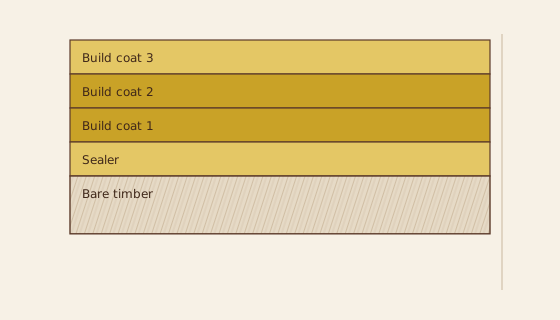
What the pad actually does
A rubber is cotton wool wrapped in a linen or muslin cloth, folded into a pear shape with a flat sole. The sole carries a thin film of shellac and a trace of linseed oil; the oil is a lubricant, not part of the finish, and it exists so the pad glides instead of grabbing.
Three motions happen at once. The pad is moving in a long oval along the grain, it is applying a coat on the forward half of that oval, and it is burnishing the coat that went down on the previous pass on the back half. That is why a French-polished surface builds faster than the coat thickness suggests: every pass is also polishing what is already there.
The three stages, and how you know each is done
<strong>Filling.</strong> Shellac and pumice worked into the open grain until the pores stop drinking. On walnut this takes 6 to 10 passes. You know it is done when a raking light shows the grain filled but not buried, and when the pad starts to feel like it is sliding rather than soaking.
<strong>Bodying.</strong> Straight shellac, no pumice, in thin coats: 12 to 20 passes, loaded lightly and often. The film builds to maybe 25 microns. You know it is done when the surface reads even from every angle you can get your head into. Unevenness that only shows at one angle will show at every angle once the finish cures for a week.
<strong>Spiriting off.</strong> A pad with alcohol only and a very light oil charge, wiped in fast straight strokes with the grain, no pressure. This melts the very top of the film and levels the swirl marks left by bodying. It is the stage that either makes the job or clouds it, and it is the stage to stop early on rather than push through.
Bench note: Spiriting off is where every beginner ruins a good bodying job. If the pad starts to feel sticky, it is out of oil and it is pulling the film back off. Reload, or stop. Stopping is always available and re-bodying takes twenty minutes.
Where it belongs, and where it does not
French polish belongs on pre-1900 furniture, on pieces where the original finish was shellac, and on anything where you want a finish you can repair invisibly. A scratch in French polish is fixed by padding one more coat onto it, and no other finish in the trade offers that.
It does not belong on a kitchen table, a bar top or a bathroom vanity. Shellac is not water-resistant, not alcohol-resistant and not heat-resistant. A glass of wine left on a French-polished top overnight will leave a ring that needs a full re-bodying to remove.
Comparison: what each finish does when something goes wrong
- French polish: a scrape is padded out in 15 minutes, invisibly.
- Wiping varnish: a scratch gets a spot coat wiped on; usually visible on close inspection.
- Brushed polyurethane: a repair requires sanding the whole panel back and recoating; the repair is visible for months.
- Catalysed lacquer: a repair requires spraying a whole panel; a spot repair cannot be blended.
One traditional technique, described in general terms. Flammable solvents and repeat exposure are real risks; this page is information only.