Bench / Projects / Mahogany Nest of Three: French Polish Lost to Water and Heat
Mahogany Nest of Three: French Polish Lost to Water and Heat
Three mahogany occasional tables with a French-polished finish that had gone cloudy white across the tops and had worn through to bare veneer along every edge. Six body coats went back on, and the whole job is really about grain filler rather than polish.
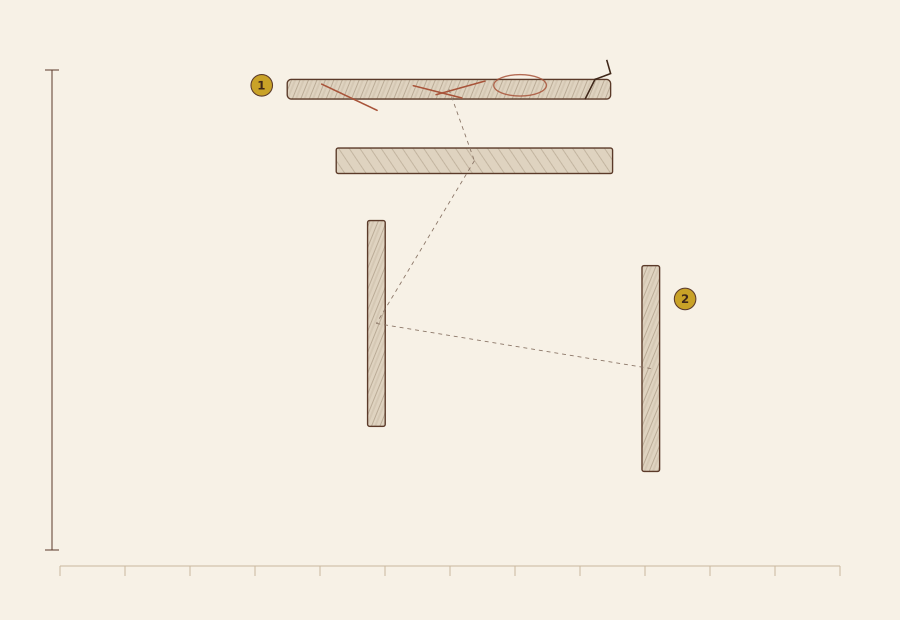
 Before
After
Before
After
| Field | Value |
|---|---|
| Piece | Nest of three occasional tables |
| Estimated date | 1925-1940 |
| Substrate | Veneer over ground |
| Old finish removal | Solvent (DCM-free) |
| New finish system | Shellac / French polish |
| Coats | 6 |
| Dry between coats | 3 h |
| Bench hours | 12 h |
| Materials cost | CNY 200-280 |
What a ruined French polish actually looks like
Three mahogany occasional tables that nested, square tops on slender cabriole-ish legs, about 1930s. The finish had failed in the two ways French polish always fails.
The first is water: white clouding across the tops, the classic bloom that happens when moisture gets into the shellac film and stays there. It looks like damage to the wood but it is entirely in the film. The second is heat and wear: every edge and every place a glass had stood had gone through the shellac to bare wood, and the bare wood had then dirtied.
Nobody had ever filled the grain. Mahogany is an open-pored timber and a French polish that has not been grain-filled will sink into the pores over twenty years and finish up looking like a bad oiling, all texture and no depth.
Bloom, wear and grain are three separate problems
Sorting them out before touching anything is most of the job.
Bloom is fixable in place. Alcohol reflows the top of the shellac film and the clouding goes with it, which means a lightly bloomed surface does not need stripping at all.
Wear through to bare wood is not fixable in place. The damaged area needs colour matched and built back up level with the surrounding film before anything else goes on top.
Open grain is not fixable with more polish. Shellac will not fill a mahogany pore; it bridges it, dries, and then the bridge collapses on the next coat. Filler first, always.
Bench note: A drop of alcohol on the bloomed area, left 30 seconds, tells you which problem you have. If the white goes and comes back clear after it dries, it is bloom. If the white goes and the wood underneath is pale and dirty, you have wear as well.
Clean, then decide how much comes off
Denatured alcohol on a grey Scotch-Brite pad, worked evenly over a whole panel at a time, never in spots. This takes off the dirt, the old wax and the top of the bloomed film in one pass. On these three tops the bloom went completely; only the worn edges were left requiring more than this.
Work panel by panel and finish a panel before moving on. Half-finished panels show overlaps forever.
Grain-fill before anything else
Neutral paste filler, thinned to the consistency of single cream, applied across the grain with a 100 mm squeegee and immediately wiped back across the grain with a hessian rag. Then, once it has flashed off to a matt haze — about 15 minutes — wiped along the grain with a soft cloth to clear the surface. Two applications on these tops, eight hours apart.
Get the wiping direction right and this is easy. Wipe off across the grain and you drag the filler back out of the pores, which is the single most common reason a grain-filled top looks unfilled.
Match the colour on the worn edges
Aniline dye in alcohol, mahogany red-brown, mixed very weak and built up in passes rather than mixed to strength. A weak dye that needs four passes gives you three chances to stop; a strong dye gives you none. Applied with a flat artist's brush, feathered 15 mm into the good finish so there is no step.
Then a coat of thin shellac over the dyed area alone to lock the colour. Dye that has not been sealed will lift the moment the polishing rubber goes near it, and it lifts into the polish, not out of the wood, which means it is now in the wrong place as well as gone.
Six body coats with a rubber, not a brush
Rubber: a cotton wad inside a 200 mm square of unbleached linen, charged with a 1.5 lb cut of dewaxed blonde shellac, one drop of raw linseed oil on the face. Circles, then figures of eight, then straight passes along the grain to finish each session. Six coats, three hours apart.
The oil is a lubricant, not an ingredient. Too much and the polish slides instead of building; none at all and the rubber grabs and leaves a ridge. One drop per rubber charge.
Level between coats rather than at the end
Between coats, a very light pass with 4F pumice on a felt block, barely touching. Level as you go and the final surface needs almost nothing; leave all the levelling to the end and you cut through six coats in one place while filling nothing anywhere else.
The end grain of the legs took four extra coats on its own. End grain drinks shellac and always needs more than the face grain next to it.
Burnish out with rottenstone and finish with wax
After the last coat has hardened for 48 hours, rottenstone and raw linseed oil on a felt pad, straight passes along the grain, until the surface is uniformly satin. Then a coat of beeswax polish with no silicone in it, left 20 minutes and buffed off.
Do not chase a mirror. A 1930s table with a mirror finish looks wrong and shows every speck of dust for the next ten years. The target is a soft, deep satin that lets the mahogany figure read.
A record of one set of tables, not a course in French polishing. Shellac and alcohol are flammable — work from the product data sheet and treat this as information only.
Abrasive ladder

Grit sequence, coarsest first — each step removes the scratches of the one before.