Bench / Glossary / Wiping Varnish: Thin Coats, Fast Recoats, and No Brush Marks to Fix
Wiping Varnish: Thin Coats, Fast Recoats, and No Brush Marks to Fix
A wiping varnish is an ordinary oil-polyurethane varnish thinned far enough that it can be applied with a rag. It builds slowly and it cannot be applied too thickly, which is exactly why it is the finish most likely to come out well on a first attempt.
What it is, in one paragraph
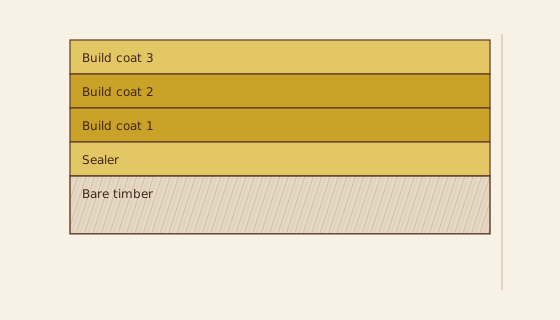
Take an oil-modified polyurethane varnish and thin it 1 part mineral spirits to 1 part varnish, and it stops behaving like a varnish and starts behaving like an oil. It can be wiped on with a rag instead of brushed, it goes on in a coat about 8 microns thick instead of 40, and it tacks in twenty minutes rather than four hours. Three or four of those thin coats build a film roughly as thick as one brushed coat, but without the brush marks, without the sags, and without the dust nibs that a slow-drying thick coat collects.
The dilution is what makes it forgiving. A thick coat of varnish that is applied unevenly stays uneven; a thin wiped coat that is applied unevenly levels itself in the first minutes, because there is so little material to level.
The mixing ratio and why it is not fixed
One to one is the starting point, and it is the ratio for a first coat on bare, open timber, where you want the finish to soak rather than sit. Subsequent coats go richer: two parts varnish to one part mineral spirits, then three to one for the last coat.
The variation is not a trick, it is a consequence of what the coat has to do. The first coat's job is to seal the surface. The last coat's job is to be the surface. Those are different jobs and they want different viscosities.
Mix in a glass jar with a lid and label it. Thinned varnish has a shelf life of months, not years, and an unlabelled jar of brown liquid in a workshop is a hazard rather than a convenience.
How to apply it so it comes out even
Fold a 200 mm cotton square into a pad, dip it, and wring it out against the side of the jar so it is damp rather than wet. Then work in sections no bigger than 400 mm square: wipe on with the grain, immediately wipe back with a dry part of the rag, and move on. The second wipe is what makes the coat even, and it is the step people skip.
Work from the far edge back towards yourself so you are never reaching over wet finish. Finish a whole panel rather than half of one; a partly done panel shows the overlap line under the next coat.
Between coats, 24 hours for the first, 12 for the ones after. Scuff with a grey Scotch-Brite pad, dust off, wipe with a tack cloth, and go again.
Comparison of film build on a walnut top
- One brushed coat: about 40 microns wet, 18 dry, dries in 4 to 6 hours, requires brush-mark levelling.
- One wiped coat at 1:1: about 8 microns wet, 4 dry, tacks in 20 minutes, no levelling needed.
- Four wiped coats at increasing richness: about 26 microns dry, no brush marks, no dust nibs, and a scratch can be spot-repaired by wiping on one more coat.
General practice for one finish family. Flammable liquids and spontaneous combustion of rags are real hazards; follow the product data sheet. Information only.